
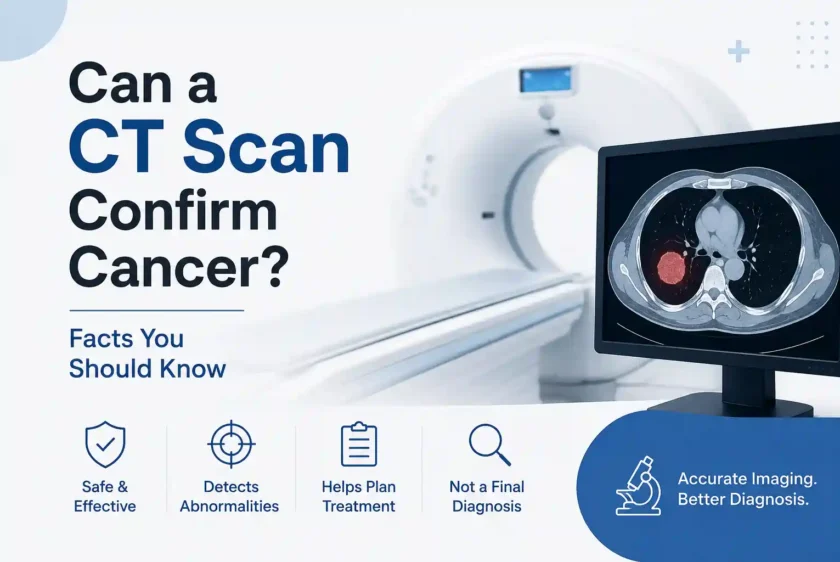
If your doctor has recommended a CT scan, you may be wondering: Can a CT scan confirm cancer? The short answer is no. A CT (Computed Tomography) scan is one of the most effective imaging tests for detecting abnormal growths and identifying signs that may suggest cancer, but it cannot definitively confirm cancer on its own. A confirmed diagnosis usually requires additional tests, such as a biopsy.
In this guide, we’ll explain how CT scans help detect cancer, their limitations, and what happens after suspicious findings are identified.
What Is a CT Scan?
A CT scan is an advanced diagnostic imaging test that combines multiple X-ray images with computer technology to create detailed cross-sectional images of the body’s organs, bones, blood vessels, and soft tissues.
Doctors use CT scans to evaluate various medical conditions, including injuries, infections, internal bleeding, and many types of cancer.
Can a CT Scan Detect Cancer?
Yes, a CT scan can detect abnormalities that may indicate cancer. It helps doctors identify:
- Tumors or abnormal masses
- Enlarged lymph nodes
- Changes in organ size or structure
- Cancer spread (metastasis)
- Internal bleeding or blockages caused by tumors
CT scans are commonly used to evaluate cancers involving the lungs, liver, pancreas, kidneys, colon, ovaries, and many other organs.
Can a CT Scan Confirm Cancer?
No. A CT scan alone cannot confirm cancer.
While it can reveal suspicious areas, imaging cannot determine whether a mass is cancerous or non-cancerous with complete certainty. Some infections, cysts, inflammation, or benign tumors can appear similar to cancer on a CT scan.
To confirm the diagnosis, your doctor may recommend:
- A biopsy (the gold standard for diagnosis)
- Blood tests
- MRI or PET scan
- Ultrasound
- Laboratory analysis of tissue samples
A biopsy allows specialists to examine cells under a microscope and determine whether cancer is present.
Why Is a CT Scan Important in Cancer Care?
Although it cannot confirm cancer independently, a CT scan plays a critical role throughout the patient’s journey.
It helps doctors:
- Detect suspicious abnormalities early
- Determine the size and location of a tumor
- Assess whether cancer has spread
- Guide biopsy procedures
- Plan surgery or radiation therapy
- Monitor response to treatment
- Check for recurrence after treatment
This makes CT imaging an essential tool in cancer diagnosis and management.
What Happens If Your CT Scan Shows Something Abnormal?
Finding an abnormality on a CT scan does not automatically mean you have cancer.
Many conditions can produce similar findings, including:
- Benign cysts
- Non-cancerous tumors
- Infections
- Inflammation
- Scar tissue
Your healthcare provider will review your medical history, symptoms, physical examination, and imaging findings before deciding whether additional tests are necessary.
Frequently Asked Questions
Can a CT scan detect cancer early?
Yes. CT scans can detect certain cancers at an early stage, especially when performed for screening or when symptoms are investigated promptly.
Is a biopsy always needed?
If a CT scan shows a suspicious mass, a biopsy is often required to confirm whether it is cancerous.
Is a CT scan accurate for cancer?
CT scans are highly accurate for identifying abnormalities and determining the extent of disease. However, they cannot determine the exact type of cells without tissue testing.
Final Thoughts
A CT scan is an invaluable diagnostic tool, but it should not be considered a definitive cancer test. It helps doctors identify suspicious findings, determine the extent of disease, and guide further investigations. If your CT scan reveals an abnormality, your doctor may recommend a biopsy or additional imaging to establish an accurate diagnosis.
Early evaluation and timely medical advice remain the best approach for improving outcomes. If you have persistent symptoms or your doctor recommends a CT scan, don’t delay your examination. Prompt diagnosis can make a significant difference in treatment planning and overall health.